
Embarking on the journey of organic certification can seem daunting, filled with precise standards and meticulous documentation. Many farmers and food producers experience apprehension about the inspection process, wondering exactly what an auditor will look for and how to ensure their practices align with the rigorous requirements. It’s a natural concern; the integrity of your operation hinges on this crucial step.
Understanding what to expect during your organic farm inspection isn’t just about compliance; it’s about validating your commitment to sustainable, life-supporting practices. It ensures that the produce reaching consumers upholds the highest purity and quality, cultivated in harmony with Natural Law. A successful inspection confirms your dedication to a farming system that respects the fundamental link between man and nature.
At the Maharishi Vedic Organic Agriculture Institute (MVOAI), we guide producers through every phase of this process, helping them prepare for and navigate inspections confidently. Our mission, since our founding in July 2000, is to reestablish the peace between farming, consciousness, and the Laws of Nature, offering robust Organic Certification Program services that extend beyond mere compliance.
What Does Organic Mean in Practice?
At its core, “organic” signifies a system of farming that sustains the health of soils, ecosystems, and people. It relies on ecological processes, biodiversity, and cycles adapted to local conditions, rather than using adverse effect inputs. It’s a holistic approach that seeks to manifest nature intelligence in every aspect of cultivation.
More specifically, organic agriculture means avoiding synthetic fertilizers, pesticides, genetically modified organisms (GMOs), sewage sludge, and irradiation. It prohibits the use of antibiotics and growth hormones in livestock. The emphasis is on building soil fertility through natural methods like composting and cover cropping, promoting biodiversity, and managing pests and diseases through cultural practices, beneficial insects, and other biological controls. As an accredited certifier under the USDA National Organic Program, MVOAI helps producers meet these exacting standards, integrating them with Vedic principle-based practices that further enhance the life-supporting qualities of food.
Understanding the USDA National Organic Program (NOP)
The USDA National Organic Program (NOP) sets the national standards for organically produced agricultural products. It’s a regulatory framework that ensures consistency and integrity across the organic industry in the United States. Adherence to NOP regulations is what allows products to bear the coveted USDA organic seal.
The NOP is overseen by the USDA Agricultural Marketing Service (AMS), which accredits third-party certifying agents, like MVOAI, to conduct inspections and certify operations. These standards cover everything from crop production and livestock management to handling and processing, ensuring that every step of the supply chain meets strict organic criteria. As the USDA explains, the NOP’s mission is to “protect the integrity of the USDA organic seal” by establishing consistent national standards for organic agricultural products (USDA Agricultural Marketing Service).
“Organic certification is a meticulous process, but it’s essential for upholding consumer trust and ensuring that products marketed as organic truly meet the highest standards of ecological integrity and health.”
Our deep knowledge of organic standards and Vedic agricultural principles allows us to support farmers in not only meeting but exceeding these requirements. We believe that true organic integrity extends to the consciousness with which food is grown, leading to products of the highest purity and quality.
Farm Inspection Checklist: What Do Inspectors Look For?
During an organic farm inspection, the certified agent’s inspector meticulously verifies that your operation complies with your Organic System Plan (OSP) and all applicable NOP regulations. This involves a thorough review of records, an on-site examination of your farm, and interviews with personnel.
An inspector’s visit is a detailed audit. They’ll confirm that your farm practices, inputs, and record-keeping align with the organic standards you’ve committed to. This isn’t just about identifying problems; it’s about validating your entire organic system. For producers interested in USDA Organic Certification Requirements, understanding this checklist is paramount.
Key areas an inspector will focus on include:
- **Organic System Plan Review:** They’ll confirm that all practices described in your OSP are being implemented. Is your crop rotation plan followed? Are pest management strategies consistent with organic principles?
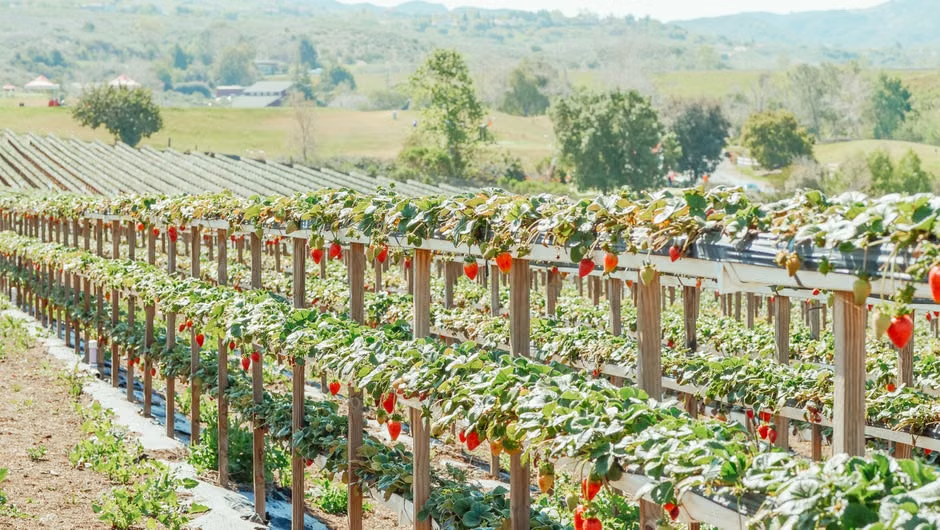
- **Field and Facility Walk-Through:** The inspector will visually confirm practices. This includes examining fields for prohibited substances, observing buffer zones, checking water sources, and verifying the management of compost and manure.
- **Record Keeping:** This is critical. They’ll review purchase records for organic seeds and inputs, sales records, harvest logs, soil test results, and any records related to pest or disease management. Traceability is key; you must be able to track organic products from seed to sale.
- **Equipment Cleanliness:** For processors, or farms with both organic and conventional operations, equipment must be cleaned to prevent commingling or contamination.
- **Ingredient Verification:** For operations that handle or process organic products, the inspector will check labels, certifications for all organic ingredients, and segregation procedures.
- **Worker Training:** Evidence that workers understand organic practices and their role in maintaining organic integrity is often reviewed.
“Maintaining detailed and accurate records is perhaps the single most important aspect of a successful organic inspection. Documentation provides the verifiable evidence that your practices align with organic standards over time.”
How to Get an NOP Certificate: The Certification Process
Obtaining an NOP certificate involves several distinct steps, each designed to ensure your operation meets the high standards of organic integrity. It’s a structured journey, but one that is ultimately rewarding, confirming your dedication to life-supporting agriculture.
The process generally begins with choosing an accredited certifying agent, like MVOAI, who aligns with your values. Then, you’ll develop an Organic System Plan (OSP) that details how you’ll comply with the NOP regulations. This plan covers everything from production and handling to record-keeping. Once your OSP is submitted and reviewed, an on-site inspection is scheduled.
Here’s a simplified overview of the certification process:
- **Application Submission:** You’ll submit a detailed application and your Organic System Plan (OSP) to your chosen certifying agent. This plan describes all organic practices you intend to follow.
- **OSP Review:** The certifying agent reviews your OSP to ensure it complies with all NOP regulations and identifies any areas needing clarification or adjustment.
- **On-site Inspection:** An inspector visits your farm or facility to verify that your actual practices match your OSP and meet organic standards, as detailed in the checklist above.
- **Certification Decision:** The certifying agent evaluates the inspector’s report and your OSP. If all requirements are met, they issue your NOP certificate.
- **Annual Inspections and Updates:** To maintain certification, you’ll undergo annual inspections and update your OSP as needed.
Our experience with multi-national government certifications, including USDA, EU, and Japan (JAS) regulatory recognition, positions us uniquely to guide you through these intricacies. We’re committed to making this process transparent and achievable for all dedicated organic farmers.
What to Expect After the Inspection and Beyond
After the on-site inspection, the inspector compiles their findings and submits a report to your certifying agent. This report details their observations, any non-compliances, and recommendations. The certifying agent then reviews this report, along with your OSP and any additional documentation, to make a certification decision.
You’ll receive a formal decision. If minor non-compliances are found, you might be given a timeline to address them before certification is granted. If major non-compliances are identified, certification may be denied. However, with proper preparation and guidance, such as that provided by MVOAI’s seasoned experts, successful outcomes are the norm. Our team has direct experience certifying organic producers and food processors and understands the nuances.
Once certified, your operation will be listed in the NOP Organic Integrity Database, a public-facing tool that allows consumers and businesses to verify the organic status of operations. This transparency builds trust and accountability within the organic market.
Is Organic Certification Always the Best Path? Nuanced Suitability
While organic certification offers substantial benefits, it’s not the only path for every farmer, nor is it always the most suitable first step. Some small farms might find the initial investment in time and resources for certification prohibitive, even if they already practice organic methods. For these producers, selling directly to consumers through farmers’ markets with transparent explanations of their practices can be a valid alternative.
Moreover, while the NOP sets a baseline for organic, MVOAI goes further with our Vedic principle-based approach. We understand that “Organic Is Not Enough” to truly enliven the food with nature’s intelligence. For producers seeking to integrate consciousness-based agriculture, considering our specific Maharishi Vedic Organic Agriculture label alongside USDA organic certification can offer a distinct advantage, elevating food quality beyond mere chemical composition. We also recognize that some farmers might explore other regenerative agriculture certifications or local food initiatives that align with their community’s specific needs, which can be valuable stepping stones or parallel paths.
Practical Tips for a Smooth Organic Inspection
Preparing thoroughly for your organic inspection is paramount. It reduces stress and increases the likelihood of a seamless process, allowing your operation’s true dedication to organic principles to shine.
- **Maintain Meticulous Records:** Keep all documentation organized and readily accessible. This includes input invoices, sales receipts, field activity logs, soil tests, and pest management records. Consistent record-keeping demonstrates compliance over time.
- **Review Your Organic System Plan (OSP) Regularly:** Ensure your practices always align with what’s documented in your OSP. Update it whenever you make significant changes to your operation.
- **Understand Buffer Zones:** Clearly delineate and maintain buffer zones between organic fields and any adjacent conventional land. This prevents prohibited substances from drifting onto your organic crops.
- **Train Your Team:** Ensure everyone involved in your operation understands organic standards and their role in maintaining organic integrity. Richard Mort, our founder, often emphasizes that a well-informed team is crucial for consistent application of organic principles.
- **Conduct Internal Audits:** Periodically perform your own “mock inspections.” Review your records and walk your fields as an inspector would, identifying any potential areas of non-compliance before the official visit.
- **Communicate with Your Certifier:** Don’t hesitate to ask your certifying agent questions if you’re unsure about a specific requirement or practice. Proactive communication can prevent misunderstandings.
The organic inspection process, while rigorous, serves as a vital affirmation of your commitment to sustainable and consciousness-based Organic Farming. It’s an opportunity to demonstrate your dedication to producing food that is truly life-supporting, reflecting the harmonious relationship between man and nature. By understanding the process, preparing diligently, and leveraging the expertise of MVOAI, you can navigate your certification journey with confidence, bringing your highest quality produce to the world.